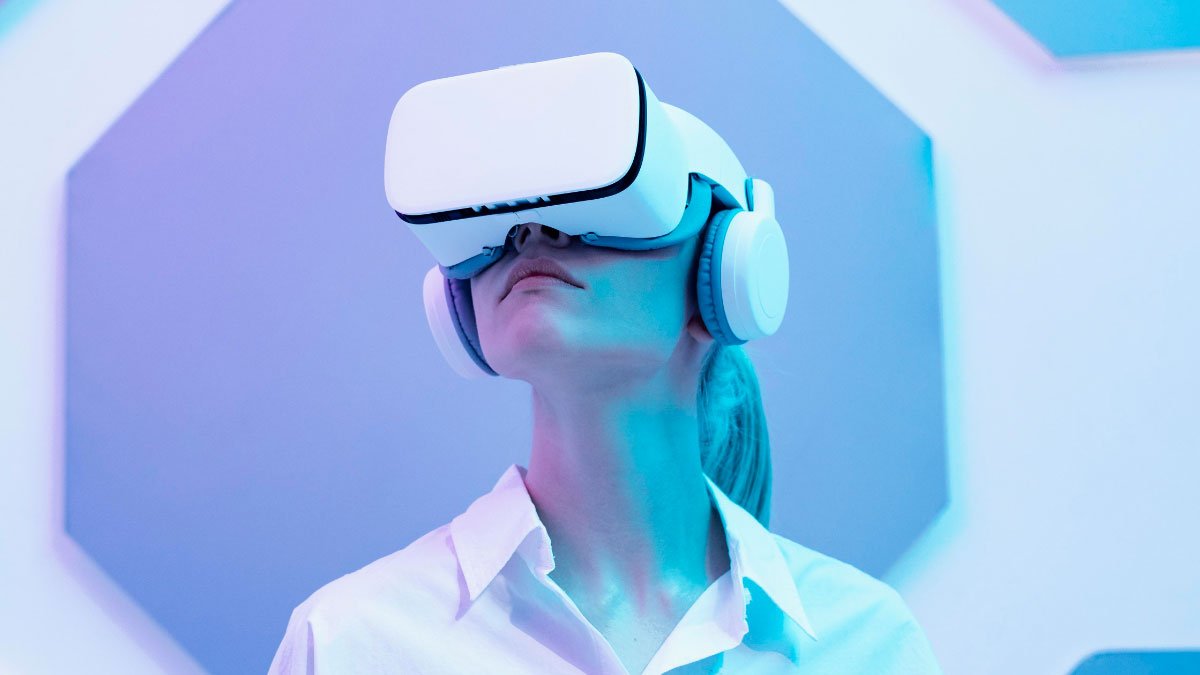

Have you ever wondered that there will be a mobile phone and you will have access to call somebody in nanoseconds?
It’s the impact of technology, and we never wonder that it is going to stop because it is operating itself day after day.
The question is, will we always be staring down at the same phone screen, or something bigger is coming? It’s quite a curiosity-based question.
You must listen to Meta, which is a company behind Instagram, WhatsApp, and Facebook, which is working on different areas.
They believe that one day, instead of pulling out your phone, you just need to simply put on a pair of smart glasses, and you can see everything you need floating around in front of your eyes.
There will be no need for any screen, no need for any device to hold, just around you everything, every digital information will be layered on top.
This is the meta’s vision, which is quite interesting, but turning it into reality is quite challenging and costly. Meta has invested an almost unbelievable amount of money in these projects.
In this blog, we are going to discuss everythingear glasses regarding AR and VR, and we will see how Mark Zuckerberg is thinking.
By the end, you will have a clear picture of one of the biggest and boldest steps in the history of technology. Let’s dive into the blog.
What is Meta?
Mostly, people now think of Meta as the company behind Instagram, Facebook, and WhatsApp. It is one of the largest tech companies in the world.
They generate a huge amount of money every year. In just the first three months of 2026, Meta made $26.8 billion in profit and earned $56.3 billion in revenue, which is huge. The company is clearly doing very well financially.
Here is the interesting part: Meta is also losing billions of dollars with the passage of time in each single quarter on a project that has not worked out yet. They are still struggling with those technologies, and the areas they are working in are different, like:
- Augmented Reality
- Virtual Reality
- AR Glasses
- Wearable Technology
- VR Headsets
Let’s discuss these things separately.
What is augmented reality (AR)?

Augmented reality, in simple words, you can say AR simply means adding digital things on top of the real world.
Here is a simple example. Suppose you are walking down a street and wearing special glasses. Those glasses show you arrows pointing you in the right direction and helping you in navigation, floating in the air in front of you, something like that.
You can’t imagine that you are wearing sunglasses and everything will float in front of you, which is actually not existing in reality, but with the help of the glasses you can experience that.
You can still see the real street, but digital information is added on top of it, which is amazing.
Another example: if we take that you are shopping online for a mobile phone with augmented reality, you can point your phone at your living room and you can see exactly how that mobile phone would look in your home before buying it. It is not specified with only the phone.
Maybe you are going to purchase some chairs, so you can just drag them into your home and you can see how it will behave and how it will look.
You can build your imagination into reality just like that. That is augmented reality, which we call AR.
It doesn’t replace reality; it just adds useful or fun digital things on top of it, which is quite interesting to see.
Suppose, for example, you are just looking forward to painting your walls in your room and you want to see how that color will look in real time. With that, you can just experience it without investing the cost into the paint, and after the experience is how it will look.
You just, with the help of AR, can experience it earlier before investing in your paint, so this is augmented reality.
What is virtual reality (VR)?

Virtual reality is the opposite of augmented reality in one key way: it replaces the real world completely.
When you put on a VR headset, you stop seeing your room. Instead, you are inside a fully digital world.
You can look around, walk through it, and interact with things. It will actually feel like you are there.
It will give a true meaning of that thing, like you are sitting there and you are experiencing things there.
Virtual reality is often used for video games, in medical therapy or job training, and in multiple other things.
The struggle of Meta is to also become a place where people hang out, socialize, and work just like in the real world but in digital. It is quite different and quite an interesting thing. It will seem like there is a world into a world.
For example, there is a globe, and inside there will be the second globe.
Just like you are living in real time, with the help of virtual reality you will go into another world where you can digitally experience multiple things, which is quite different and quite hard to imagine.
Meta is also investing in that, and they are struggling for that also.
What are AR glasses and how is Meta working on them?
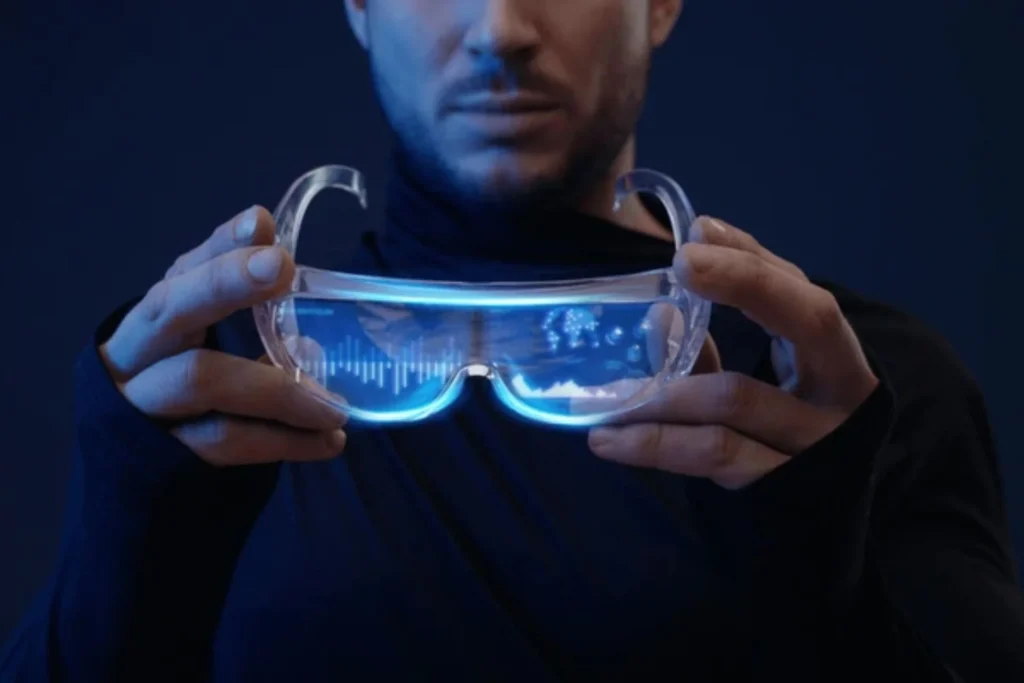
Meta has already introduced Ray-Ban smart glasses with a very popular eyewear brand, and they have partnered with them.
These look just like regular sunglasses, but they include a small camera speaker, and it also includes a built-in AI assistant.
You can play music, you can ask questions, you can make calls, and you can also take photos with that.
All things can be done without touching your phone, which is quite interesting, and the bigger project is known as Orion.
These are the glasses that actually show holograms in front of your eyes.
In reality, imagine seeing a text message floating in the air or a video call appearing right in front of you.
They look like normal glasses but actually you are seeing the chit chat and messaging from your friends, like somebody is calling you for dinner or somebody is calling you to do some projects regarding the web development or something like that, maybe different apps or something in front of you.
You can just see, but you are just wearing some glasses that could one day replace your phone entirely.
It is quite a big project, and Orion is still being developed and not available to buy yet, but it shows exactly what Meta is working on.
What is VR software?

If you have a good headset, it is not going to be enough in the future. You also need good things to do inside it.
Meta has introduced a virtual world called Horizon Worlds where communities can meet, hang out, and play just as cartoon avatars in a virtual world.
It feels like they build Horizon Workrooms, a virtual office space where remote teams can have meetings inside VR, which will seem quite interesting and also sometimes makes people excited about what will happen in this world if VR will come, like how in reality people are hanging out in virtual reality.
It is quite different to imagine, but let’s see where things are going to proceed.
There are not many people who use them regularly. The graphics were criticized for looking too simple, and it just was not enough to keep the people coming back.
There are a lot of challenges for Meta. Without great software, the community and humans have no reason to use the headsets, and without a lot of users, developers have no reason to build great software.
It is a difficult cycle to break, so this is also a reality.
Many times not everything is going to be at the peak, but sometimes things need to be refined and reimagined so that it could become a greater version.
What are VR headsets?

Meta also introduced a VR headset, which is known as Quest. The latest version of the newly launched VR headset is Quest 3.
The thing is, what is special about Quest, and the reason is that it is wireless and works on its own.
In that process, you do not need to connect it to your computer.
You just put it on, and you are inside a virtual reality. Its cost was about $500, which made it affordable for everybody who wishes to use it for the first time.
Everybody who is a lover of technology sometimes has some curiosity about VR and AR together coming into one device, which is amazing.
Meta sold millions of these headsets and leads the VR market, but even so, virtual reality is still not something most people use every day, not the way they use their phones. In reality, it exists.
If you are also interested in using VR headsets, you can try it. You can try Quest 3 and see the difference between augmented reality and virtual reality.
What is Reality Labs?
Reality Labs is also a part of Meta that builds all of the AR glasses, software, and everything related to the metaverse.
It is made up of thousands of scientists, geniuses, and designers who are working on things like custom computer chips, advanced display technology, and even on the gloves that let you feel like things in virtual reality.
Although they are losing money every single quarter, it is no laughing matter. It has increased a huge amount over the last 21 quarters.
In 2021, Reality Labs lost a total of $83.5 billion. That works out to about $4 billion every three months like clockwork, without a single profitable quarter.
It is a reality that when the technology gets successful, things become profitable and investments are recovered, but in the start it is quite hard to make the thing successful.
Although these are new things, just take an example like the mobile phone.
The first mobile phone that was launched was a very new thing for a lot of communities.
A lot of communities felt how they would use that, and mostly at that time people worried that if there is a thunderstorm, please turn off your phone that could burst (often said in rural areas in the past).
These are the fears that are usually made in the start of that technology, but the technology, when it is opted, becomes easy for everybody to hold it on, just like everybody is carrying multiple phones in their pockets right now.
After the phones, there are coming new things like augmented reality, virtual reality, and a lot of things like that.
To put that in perspective, $83.5 billion is more than the entire yearly income of many of the developing countries.
Meta has spent that much changing a future that has not arrived yet. This is the concept of Reality Labs, and these are the projects and these are the investments that they invested, but they are still looking for positive results.
How have Meta’s investors reacted?
Investors have a different mentality and they have quite a different mindset from the normal human.
The people and the organization who own shares in Meta have mixed feelings about all of this.
If we talk more about its history in 2022, when losses were growing and Meta’s ad business was slowing down, the stock price dropped by 65% in one year.
It was quite a frustrating moment for many of the investors, and they really got angry.
They felt Meta was wasting their money on a fantasy instead of focusing on what is actually going to work.
But then Meta cut costs, laid off staff, and became more focused, and the stock bounced back strongly.
By 2026, profits were at a record high, and now the investors are feeling better as compared to 2022.
Then came the latest earnings report. Despite the strong profits, Meta stock still fell more than 5% after hours.
Why?
Because Meta announced it plans to spend between $125 billion and $145 billion in 2026.
It is a huge amount that was never expected. When investors asked what spending would look like in 2027, the CFO basically said that they don’t know yet about it.
That kind of uncertainty makes investors nervous sometimes, even when the core business is going great.
It could be quite challenging sometimes to know how much the budget will be, and these things will turn the route of the investors, how they are thinking and what are the things on which they are going to invest in coming 2027.
Mark Zuckerberg, the main person behind it all.
Once Zuckerberg started Facebook in his college dorm room in 2004, he is now 41 years old and still runs the company he built, which is quite interesting to see. He is a very innovative person.
One important thing to understand is that Zuckerberg has special voting shares that give him majority control of the matter.
This means that even if every other shareholder disagrees with his decision, he can still move forward with it.
He answers to his own judgment, and as the founder of this tech giant, his decisions are final.
He is truly a believer in virtual reality and augmented reality. They are the next big things in the technology world, just like a smartphone was the next big thing after computers.
He assumes and thinks people will one day wear AR glasses the way they are now carrying phones.
On one recent earnings call, he said that Meta is spending more because the cost for things like computer memory is gradually going up, but he made it clear that Meta is not going to stop the projects.
He has also highlighted the growth of Meta AI, which got a major upgrade with the new model, which is known as Muse Spark, released in April 2026.
Meta hired over 50 top AI researchers to help build it, and Mark Zuckerberg wants Meta to compete seriously with all AI companies, the major tech giants, just like OpenAI and Claude, and others like that.
The big picture: why do these things matter?
The simple summary of everything is that Meta makes an enormous amount of money from ads on Facebook and Instagram.
It uses those profits to support its long and expensive experiments in VR and AR through Reality Labs.
That experiment cost $83.5 billion. At the same time, Meta is not only spending massively on AI, possibly even more than on virtual reality and AR.
The company projects spending up to $145 billion in 2026 on its infrastructure alone.
Mark Zuckerberg is considering that both bets will pay off. AR glasses will eventually replace phones, and AI will power everything.
The company is going to become rich enough to keep things on a better track, growing up.
Whether he is right or wrong, we will all find out together!
In the meantime, the losses keep coming: about $4 billion every three months, and Meta keeps spending without blinking.
It is quite interesting that they have the passion to make the world different as we are looking now. Things are going to be different.
Virtual reality and augmented reality are totally going to change the concept of experiences and the things, which are quite different.
Conclusion
The story of Meta is unlike anything we have seen before in the business world or in the AI world. It is a company that is wildly profitable on one side and, on the other side, while spending a huge amount of dollars on AR and VR and other things like that. It earns billions from the apps we use every day like Facebook, Instagram, and WhatsApp, and it burns through billions more trying to build the apps we might use a decade from now. It is quite interesting.
The $83.5 billion lost on Reality Labs is not a mistake or an accident. It is a deliberate choice. It is made by the founder who controls his company and genuinely believes he knows where the world is heading.
For more, if you are learning and seeking more knowledge regarding AR and VR, we are connected with THE MACRO AI. We are sharing the insights, opinions, and experiences of the daily world of AI, virtual reality, and other things like that, which is booming the world into a different mindset. Be connected with us and learn more about AI.
FAQs
What is Muse Spark?
Muse Spark is Meta’s latest and very modern AI model, which is released in 2026. It was developed after Meta hired over 50 AI researchers from rival companies.
Can AR glasses ever replace smartphones?
The technology is advancing, but it depends upon glasses becoming very reasonably priced with comfortability. Generally, if they are helping tech gadgets lovers, then definitely it can overcome all the smartphones and technology is updating day after day.
How much was the investment that Meta spent on Reality Labs in total?
In the first quarter of 2026, Meta lost a cumulative total of $83.5 billion on Reality Labs across quarters since 2021.
What are META’s AR glasses?
META is recently selling Ray-Ban smart glasses that can play music, use AI, and take photos without a phone. They are also developing ORION, which is the latest advanced prototype that can display actual holograms. ORION is not yet available for purchase, so it might be in the future that it will come into the open market.